Scotland Health Showcases Rural Innovation and Community Impact in Visit with North Carolina Healthcare Foundation
Print This Page

|
- June 30, 2026 | News Category: Hospital News, Hospital News
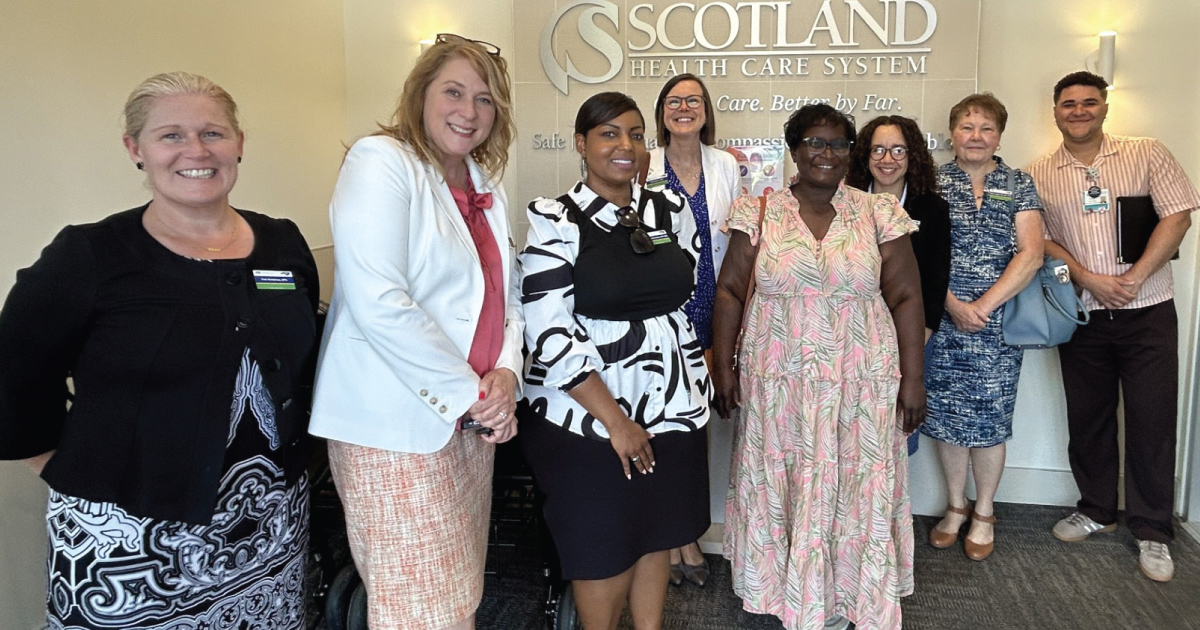
As rural communities across North Carolina search for solutions to persistent healthcare challenges, Scotland Health Care System is emerging as a model others are eager to learn from. Recently, Scotland Health hosted leaders from the North Carolina Healthcare Foundation (NCHF), the charitable and programmatic arm of the North Carolina Healthcare Association (NCHA), for an in-depth visit showcasing innovative approaches to workforce development and community-based care.
The visit brought together healthcare leaders, educators, and community partners, including representatives from Richmond Community College (RCC) and The University of North Carolina at Pembroke (UNCP), to explore how Scotland Health is improving outcomes despite significant economic and geographic barriers.
This work is made possible in part through strong partnerships. NCHF has been a key partner in this work, awarding Scotland Memorial Foundation $75,000 in recent years through its Social Impact Grant to support transportation access for patients in Robeson County—one of the region’s most significant barriers to care.
Throughout the visit, discussions continually returned to the realities facing the communities Scotland Health serves. Leaders emphasized challenges such as lower life expectancy, higher rates of poverty, and persistent disparities tied to geography.
“In our region, a person’s rural zip code predicts that they will live seven to 10 years less than someone in an urban county,” said David Pope, President and CEO of Scotland Health. “That’s the difference between seeing grandchildren grow up or not—and it’s why this work matters so deeply.”
Building a Sustainable Workforce Pipeline
Recognizing that workforce challenges are at the heart of rural healthcare, Scotland Health has developed a comprehensive strategy focused on creating opportunities, removing barriers, and investing in its people. Led by Senior Vice President and Chief Human Resources Officer Christi Meggs, the organization shared how partnerships and a “grow our own” approach are helping drive that work forward.
Over the past two and a half years, the organization has expanded to more than 1,500 team members, while reducing vacancy rates from 11.7% in 2019 to 7.17% in 2026 and significantly increasing recruitment success.
Scotland Health’s workforce strategy includes a range of innovative programs designed to build and sustain a strong talent pipeline. These efforts include a Legacy Nursing Program that provides fully funded education while allowing participants to maintain paid employment, as well as a surgical technology program developed in partnership with Richmond Community College that offers a faster path to certification. The organization also invests in early exposure to healthcare careers beginning in middle school, supports rural physician recruitment through medical student rotations with Campbell University, and strengthens internal growth through leadership development programs for emerging and established team members.
Through these efforts, applications for the nurse residency program have grown from fewer than 25 candidates in 2019 to more than 100 annually.
“Workforce development requires creativity, partnership, and long-term commitment,” Meggs said.
A Care Model Built Around the Whole Patient
In the afternoon session, led by Executive Director of Population Health and Continuum of Care Jamie Cicali, Scotland Health showcased its integrated care team model, which addresses both clinical needs and social determinants of health.
This model brings together a multidisciplinary team designed to address the full spectrum of patient needs. Community health workers and community paramedics extend care beyond the hospital walls by working directly with patients in their homes, while nurse navigators coordinate care and guide patients through complex treatment journeys. Clinical pharmacists provide specialized support for medication management, and social workers and behavioral health specialists address mental health and social challenges that can impact overall well-being. Together, this team collaborates to provide coordinated, patient-centered care that goes beyond traditional clinical settings.
“This model allows us to meet patients where they are—both in the clinic and in their homes,” Cicali said.
Scotland Health’s Community Health Worker program focuses on addressing barriers such as transportation, food insecurity, and housing—often uncovering critical needs through in-home visits.
The Community Paramedic program supports patients after they leave the hospital by helping them manage their medications, monitor ongoing health conditions, and avoid unnecessary return visits to the hospital.
A standout example of impact is Scotland Health’s maternal health initiative, which pairs nurse navigators with community health workers to support high-risk mothers.
The program has already demonstrated measurable impact, with postpartum no-show rates decreasing from 21 percent to as low as 11 percent, alongside significant improvements in access to prenatal care.
The program focuses on both clinical monitoring and addressing social barriers such as transportation and childcare.
Addressing the Transportation Barrier to Care
Access to reliable transportation remains one of the most significant barriers to care across the region, often determining whether patients receive timely treatment or delay it altogether.
Scotland Health has taken an innovative, patient-centered approach to addressing this challenge through support from NCHF and other partnerships. These efforts have enabled the development of on-demand transportation options, targeted patient ride support, and stronger coordination with community partners—all designed to respond quickly to patient needs rather than relying solely on traditional, often unreliable systems.
The impact of these efforts can be seen in real time. In one instance, a patient with a broken ankle walked to their doctor’s office without any way to get home or return for surgery. Scotland Health’s community health worker team was immediately engaged, coordinating transportation and follow-up care to ensure the patient could receive the surgery needed without delay. What could have been a missed opportunity for care instead became a coordinated, timely intervention.
“Transportation is directly tied to health outcomes,” said Cicali. “When we can remove that barrier in real time, we not only improve access—we improve outcomes.”
Scotland Health is working to sustain these programs by integrating them into reimbursable care models and demonstrating clear return on investment through improved outcomes and reduced avoidable hospital use.
Partnership at the Core
Throughout the visit, collaboration emerged as a key theme. Scotland Health highlighted the essential role of its partnerships with NCHF, Richmond Community College, UNC Pembroke, and other community organizations.
“It’s powerful to see a healthcare organization that is truly willing to partner and meet people where they are,” said Dr. Jennifer Jones-Locklear of McKenzie-Elliott School of Nursing at UNCP. “Scotland Health is not just talking about solutions – they are working together with others to make it happen.”
Tour Highlights Model of Integrated Care
The visit concluded with a tour of Laurinburg Family Practice and Urgent Care, showcasing an innovative model that brings multiple services together under one roof—including an on-site pharmacy—to improve access, coordination, and the overall patient experience.
NCHF President Dr. LaPonda Edmondson praised the hands-on experience, stating, “We appreciate not only hearing about the great work you’re doing, but to actually come and experience it.”
As Scotland Health celebrates its 80th anniversary, the organization remains focused on expanding access, strengthening its workforce, and improving community health.
“This work is about ensuring everyone—regardless of where they live—has the opportunity to live a long and healthy life,” Pope concluded.
About Scotland Health
Patient Links
For Employees
Partnerships

Accreditations